 koaches
I prepared well and still failed
Before I got into big tech, I could not work out how to interview. I was not lazy about it. I prepared well, and I kept failing anyway.
The behavioral interviews were the worst. A coding or system design interview is objective: it worked or it did not. A behavioral interview felt subjective. I would walk out with no idea what had gone wrong, so I had nothing to fix before the next one.
Then I found an interview coach. They worked with me through the whole interview journey, and that is when I saw what coaching is really for.
What a coach actually does
Looking back, a good interview coach does the same job as the coach of a sports team, or a coach in any other profession. At a professional level, a coach does not teach you the basics. You already know how to do your job. A coach does two things.
- They help you translate what you already know. You have the experience. What you are missing is how to turn it into what the other side is looking for. In interviews, that means turning your real work into answers that show a company what it needs to see.
- They help you see your superpowers and your gaps. Then they work with you, through drills and mock interviews, until the gaps close and your superpower is what makes you stand out.
That is it. A great interview coach gets you good at interviews by doing those two things, over and over.
Why you cannot easily do this alone
These are also the two things I find almost impossible for most people to do by themselves.
It is like trying to see what is in your blind spot. It is called a blind spot for a reason. You cannot see the gap in your own answer, because from the inside the answer sounds complete. You cannot see your own superpower either, because to you it is just how you work.
More preparation does not fix this. I had plenty of preparation. What I did not have was someone outside my own head telling me what the interviewer was hearing.
What changed for me
Once I understood this, my interviews went very differently, and I landed the jobs I went after.
I also learned how to coach, because I wanted to do the same for other people. That is my way of giving back to the community that helped me. I have now been coaching people through interviews for more than 10 years.
What the people I coached said
A few of the thank-yous I have had from people I coached one to one, as they wrote them.
"Mayank was an excellent coach. Haven't done interview for years, he was quick to spot gaps in the way I deliver a presentation and provided concrete actionable feedback."
XIANG"Appreciate the time and care you put into helping me! You certainly came across as a manager i'd like to work with."
Jordan"I just wanted to say a big thank you for your support and guidance. Your feedback and encouragement made a real difference in my preparation, and I truly appreciated your time and insights."
Abdul"Thank you for your help Mayank! Learnt many things about what I should say and more importantly what I shouldn't say"
sanketjoshi6"Thank you so much for the extra insights near the end! Really appreciate it :)"
Rishabh"Thank you for going over time with me to give me frameworks to think about behavioral questions!"
Andrew"Thank you so much for taking the time to chat. Your feedback was really helpful."
sasank
The catch: cost and reach
So is interview coaching worth it? For the value it gives, yes. The problem is everything around it.
I can only coach one to three people a month. And coaching is expensive: about $1,000 to $1,500 for a pack of five 45-minute sessions.
That does not scale, and it is out of reach for most people. Most people who would benefit from a coach never get one. For years I could only help a tiny part of the community.
Why I built Koaches
So I took everything from those 10-plus years of interview coaching and put it into koaches.app. It does the same two things, for anyone who is actively interviewing:
- It helps you translate your current experience into interview-ready stories.
- It identifies your gaps, runs mock interviews with you, and coaches you on how to answer, so you land the job.
Turning your experience into stories
Most of what an interviewer wants to hear is already in your work. The hard part is getting it out. In Koaches, a story coach asks you about one time from your own work, one question at a time, by typing or by voice, and follows up on what you say.
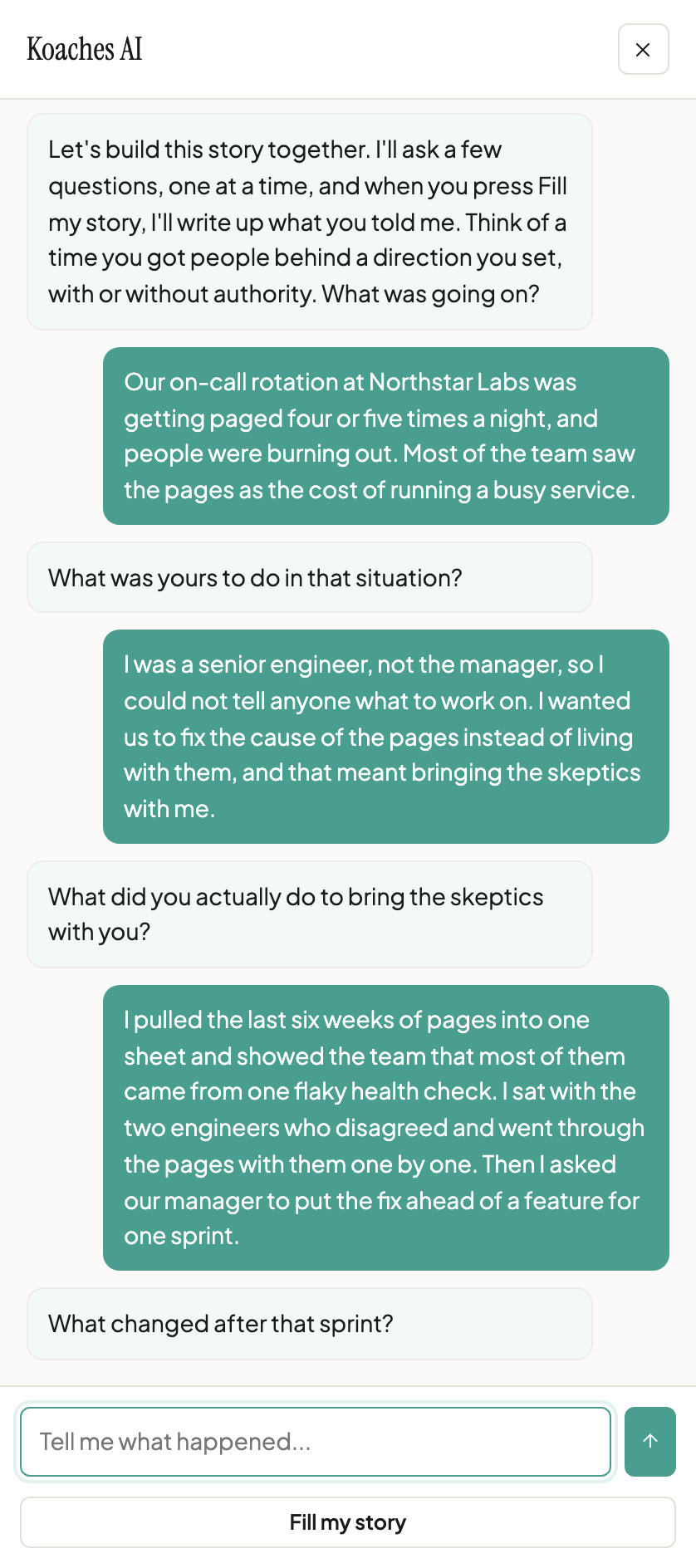
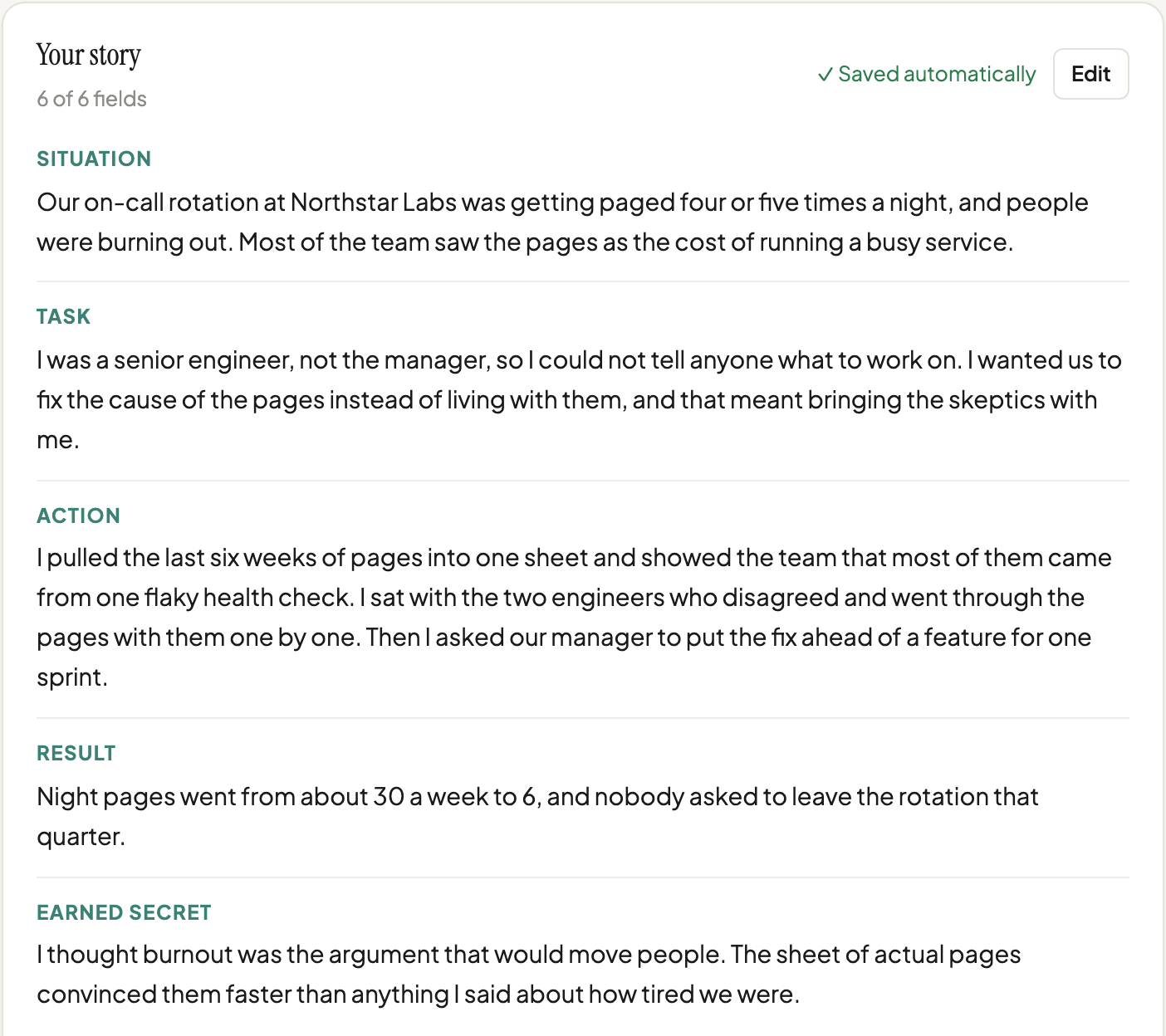
When you press Fill my story, it writes your answers into a story, using only what you said: the situation, your task, what you did, the result, and the earned secret, the lesson only someone who lived it would know.
Koaches tracks eight must-have kinds of story, from leadership and conflict to failure, and shows which ones you have. When you add a job, it can write a starting answer to any of the job's questions from your own resume and stories, with blanks for the facts only you know.
Finding your gaps, and closing them
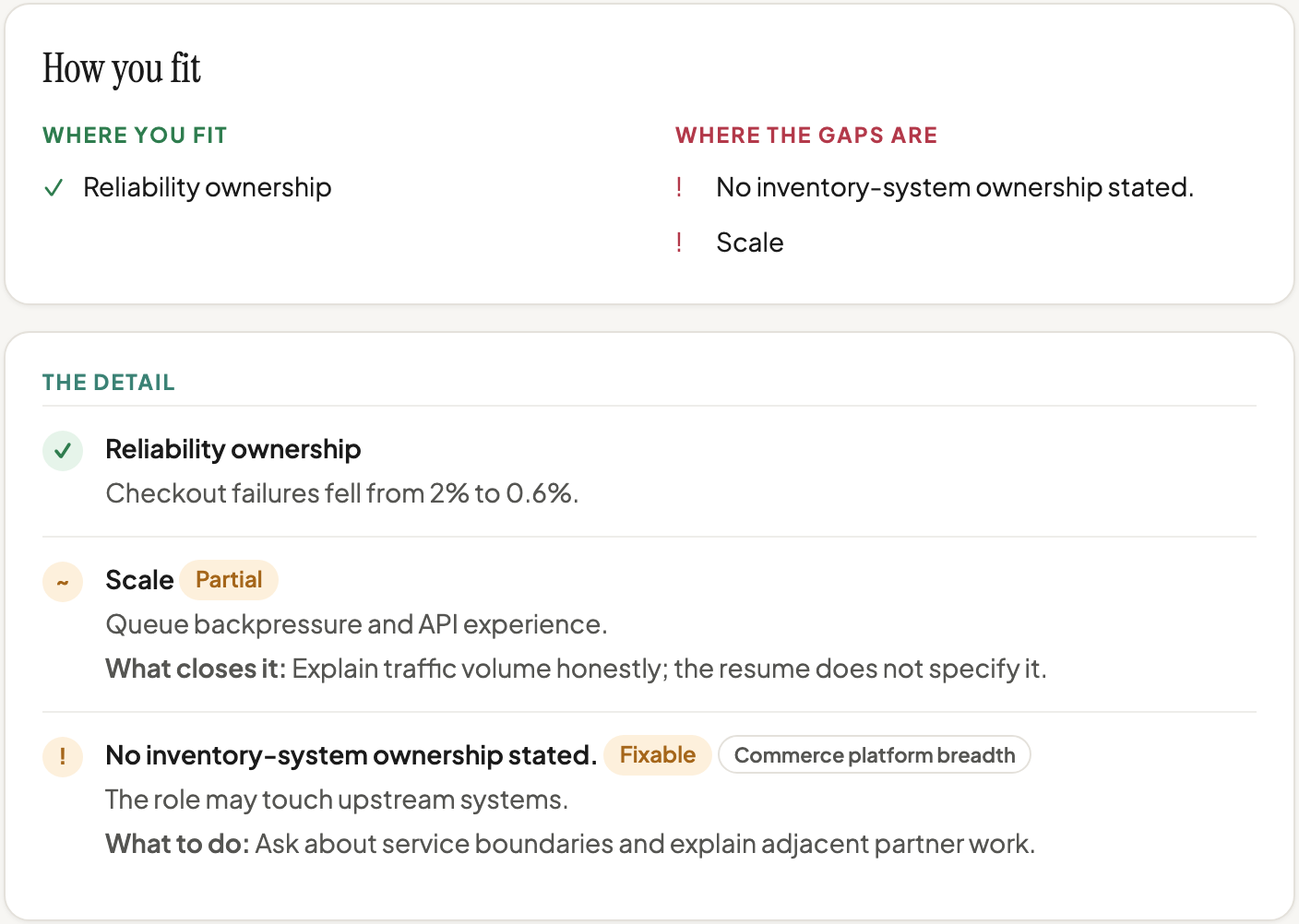
Paste the job you want, and Koaches reads it against your resume: where you fit, where the gaps are, and what to do about each one. The prep for each round then lists the gaps likely to come up in it.
Then practise, one question or a whole round, by typing or by voice. The interviewer asks follow-up questions, and you choose how hard it pushes. Every answer gets coaching: five scores, what worked, what to fix first, and a stronger version of your own answer.
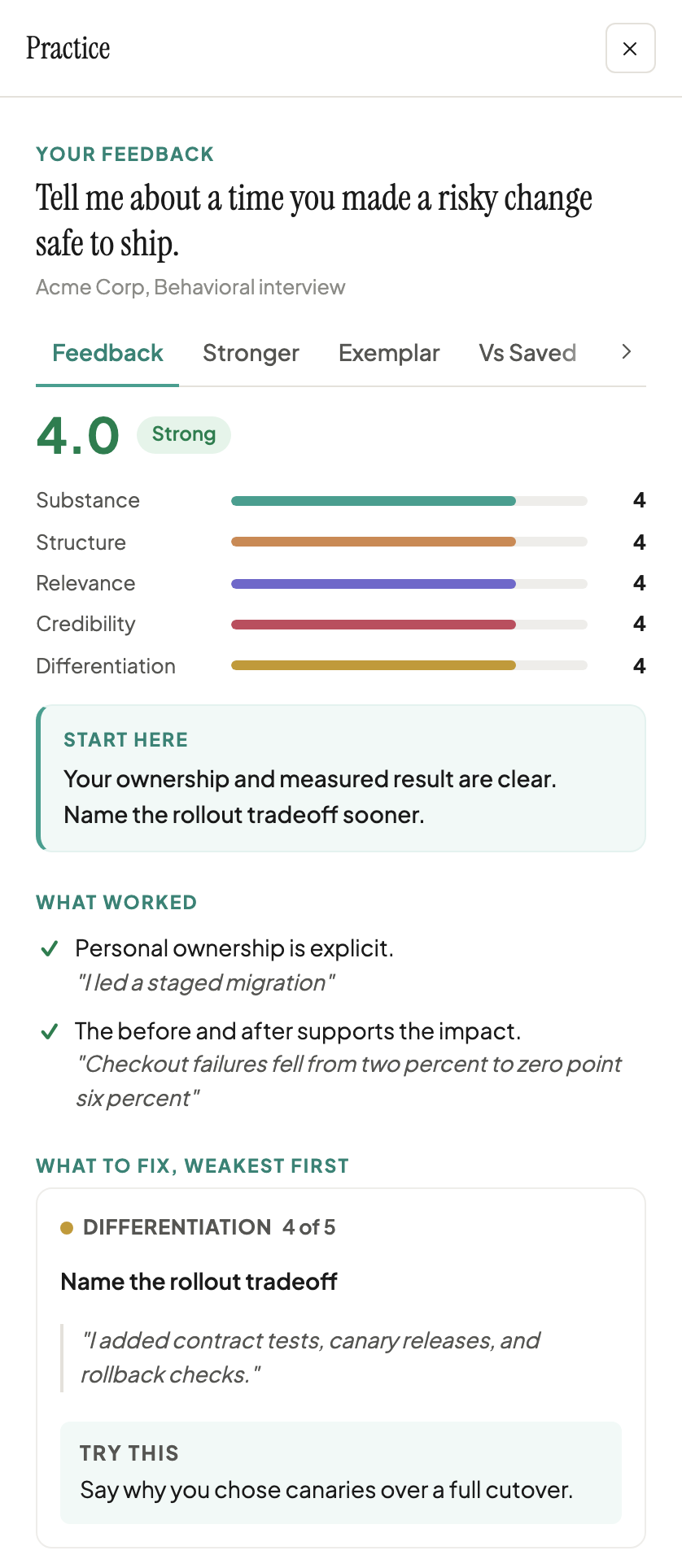
That is the drill: practise, read what to fix, and practise again.
The short answer
Interview coaching is worth it when it does those two things: translating your experience, and showing you what you cannot see yourself. That is true whether the coach is a person or a product.
If you are preparing hard and still not getting offers, the problem is probably not effort. It is probably something in your blind spot.
See what is in your blind spot.
Build your stories, find your gaps, and practise with coaching on every answer. New accounts get $5 of free credits.